 Mental Bound
Fire Protection Pro — Every inspection on time
Our own system for Greek fire-protection companies. Staff upload supplier invoices, delivery notes and their own invoices to clients, Claude reads them, a person confirms, and the system keeps the stock, the account of every installation and a maintenance schedule that reminds them before anything is due. The app is in Greek; demos are on request.

At a glance
- trades
- 10
- Extinguishers to signage and studies, plus one for everything else; every line is filed under one
- months to the next service
- 12
- Booked by a confirmed extinguisher invoice; the hydraulic test goes 60 months on
- days' notice
- 30
- Each task turns due 30 days ahead by default, on the dashboard and in the menu
- hard deletes
- 0
- Originals and readings are kept; visits, declarations and stock counts are only ever added
What we built
Reading the paperwork
Claude- Upload supplier invoices, delivery notes, combined invoice-delivery notes (ΤΔΑ), credit notes, a technician's Excel and the company's own invoices to clients: PDFs, scans, phone photos, Excel or CSV.
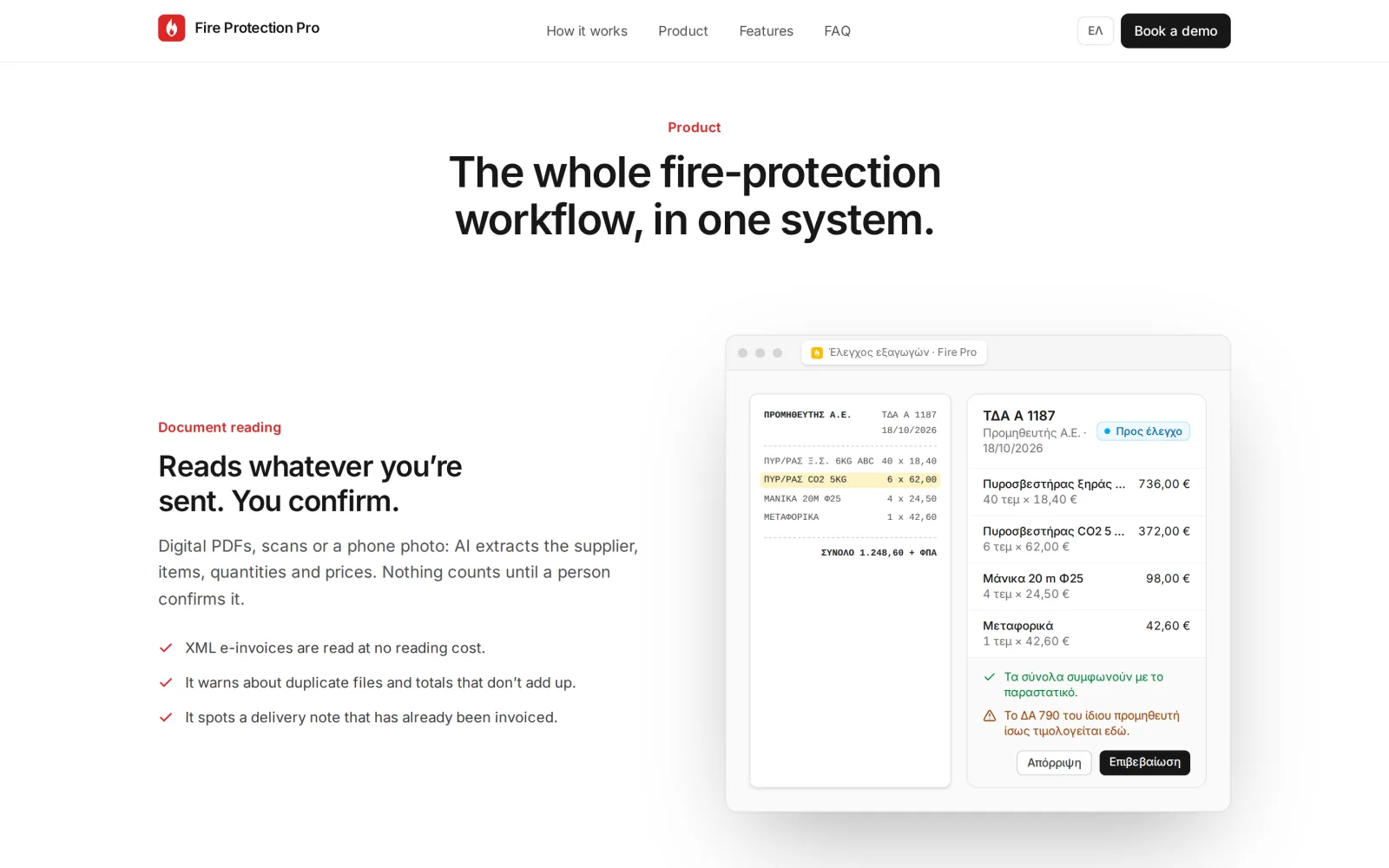
- Claude reads each one into a proposal: supplier, items, quantities, prices and discounts, copied as printed. An e-invoice's XML is read by code, at no reading cost.
- A person checks the proposal beside the original and confirms. Duplicate files, totals that don't match the document and a delivery note that may already be invoiced are flagged first.
- Nothing counts until a person confirms, and every figure is computed in SQL.
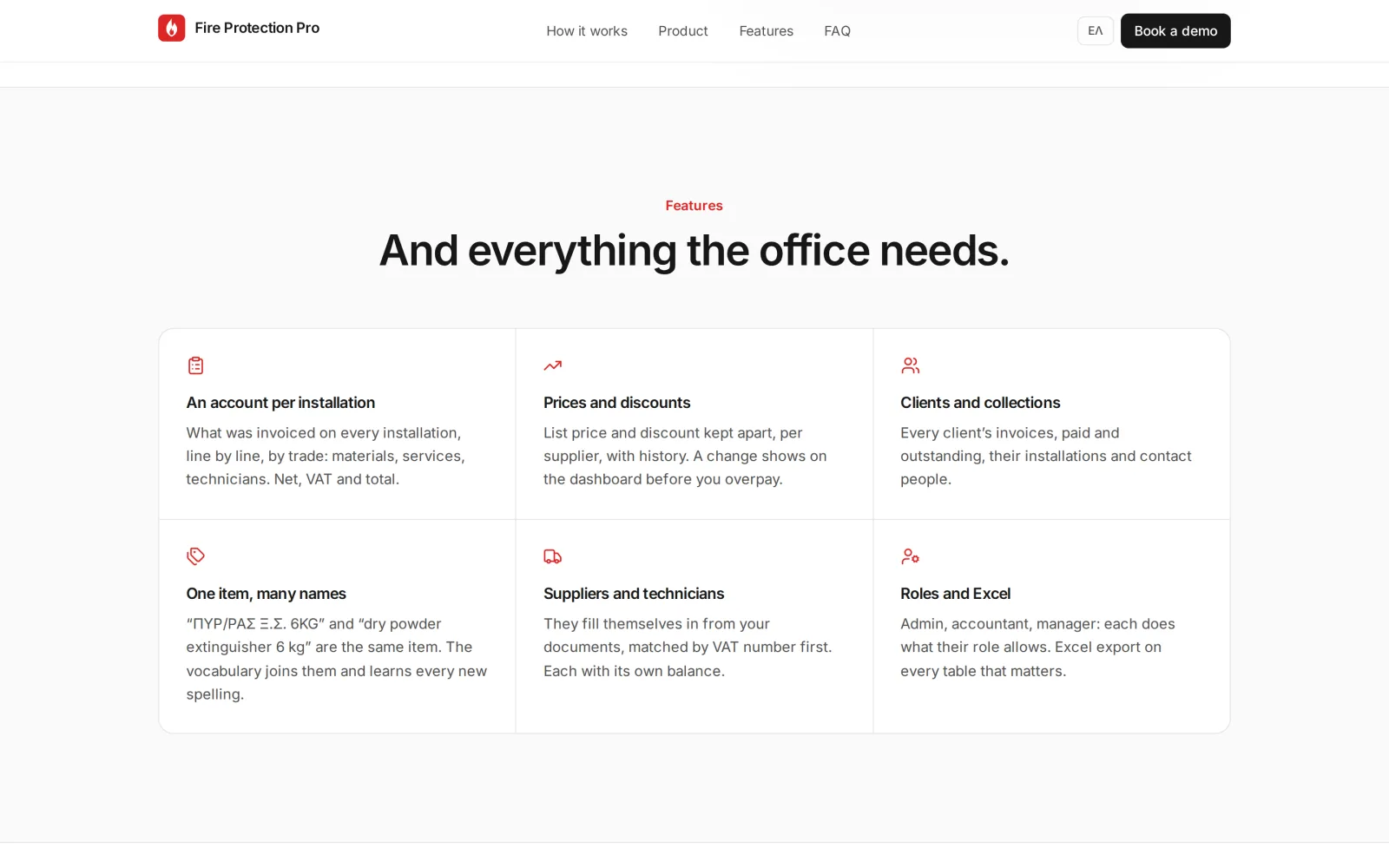
- Suppliers and technicians fill themselves in from the documents, matched by VAT number first, each with its balance. List price and discount keep separate histories, and a change shows on the dashboard.
- The vocabulary joins a supplier's wording to the company's item (“ΠΥΡ/ΡΑΣ Ξ.Σ. 6KG” is the 6 kg dry-powder extinguisher) and learns each new spelling.
- It shares its core with JobCosting.gr: both grew out of a costing system we built for a construction company.
Installations, schedule and stock
Per installation- Each installation is a client's site, with its address and its own maintenance schedule. Every task has a next date, an interval and a reminder lead time, 30 days unless set.
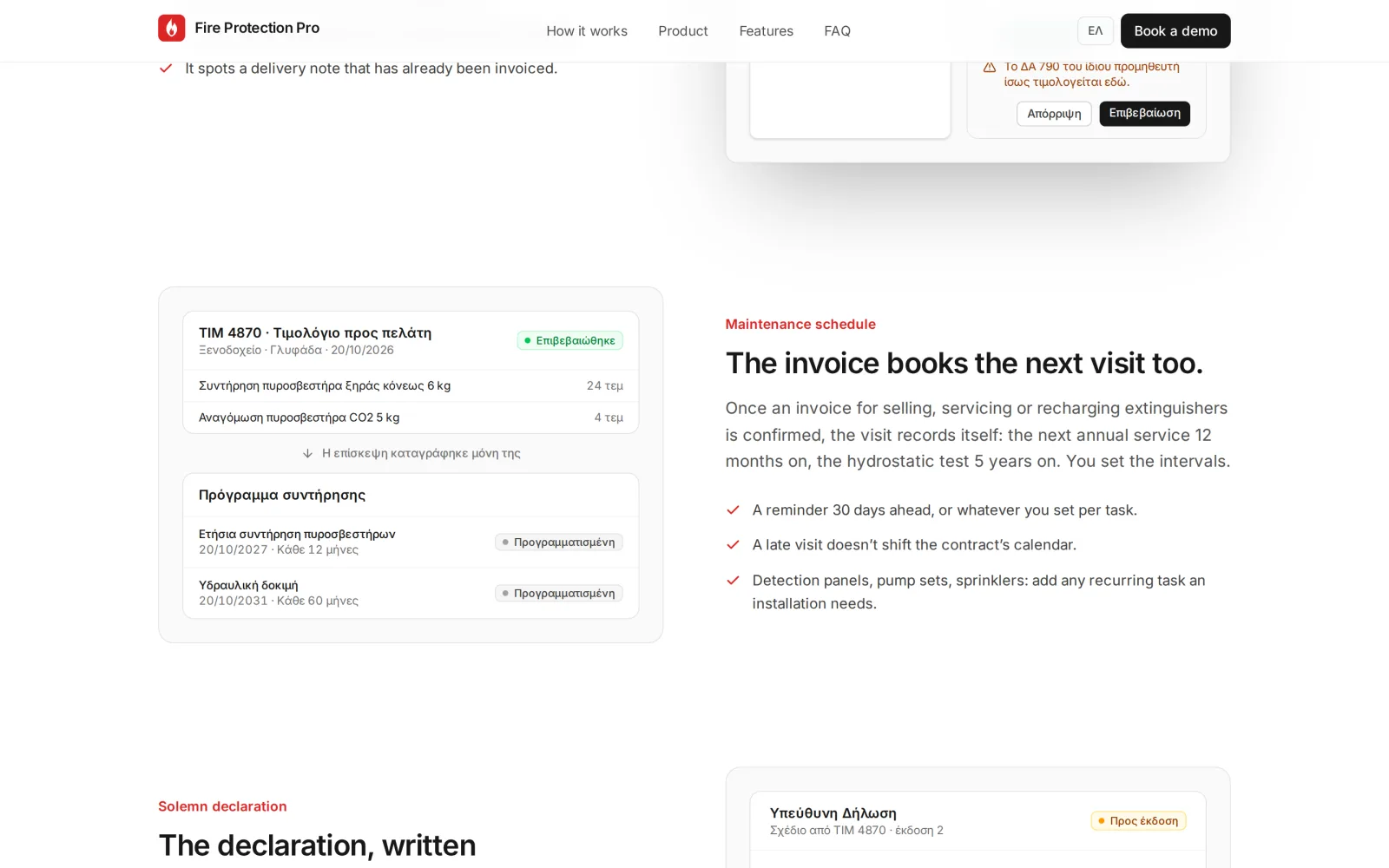
- Tasks show as overdue, due or scheduled, counted on the dashboard and in the menu. A late visit doesn't shift the contract's calendar.
- A confirmed invoice for selling, servicing or recharging extinguishers records the visit itself and books the next annual service 12 months on and the hydraulic test 60. An admin sets the intervals; other recurring tasks, such as a detection test or a pump run, are added by hand.
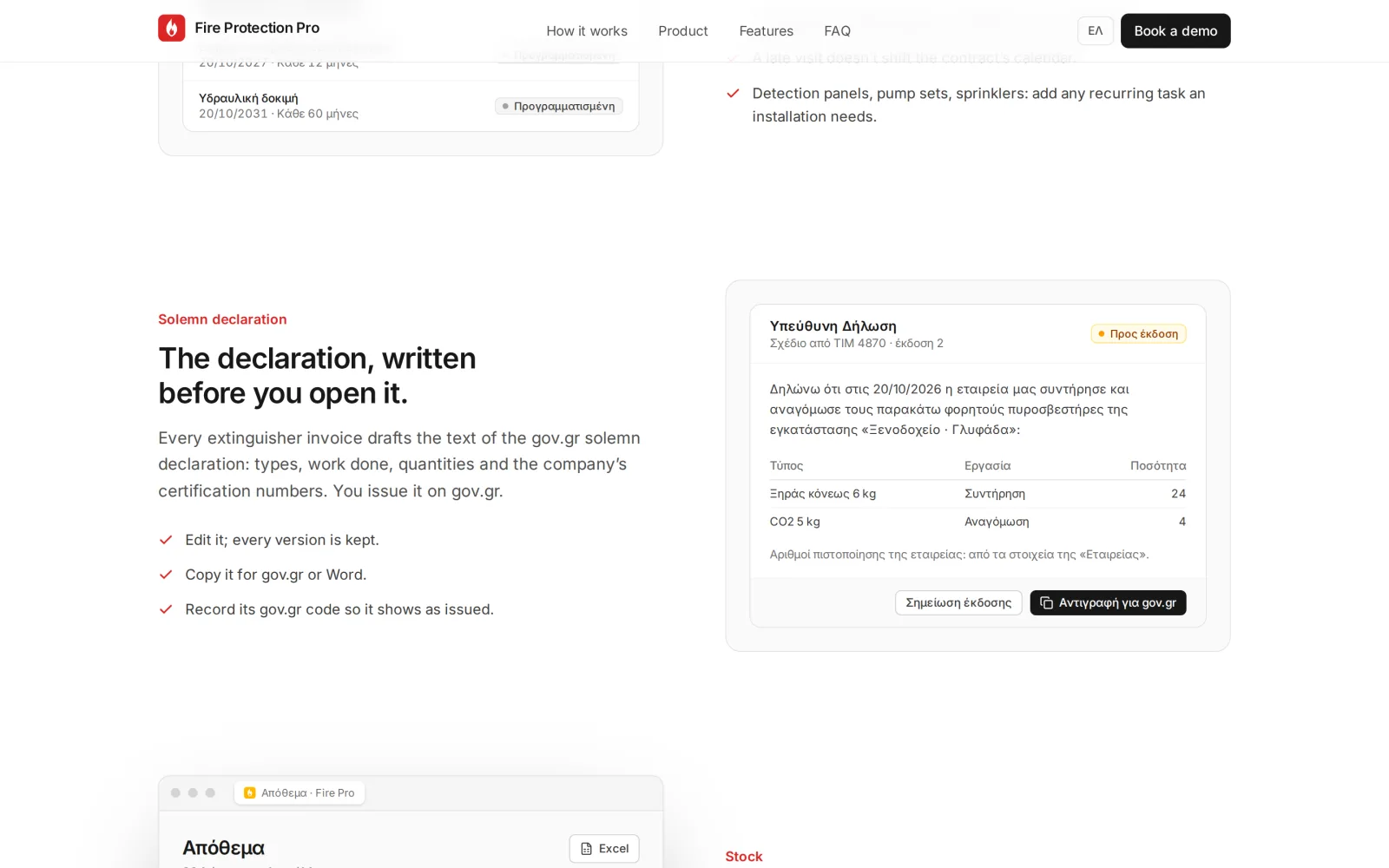
- From each extinguisher invoice it drafts the text of the gov.gr solemn declaration: editable, every version kept, copied for gov.gr or Word. A person issues it on gov.gr and records its code.
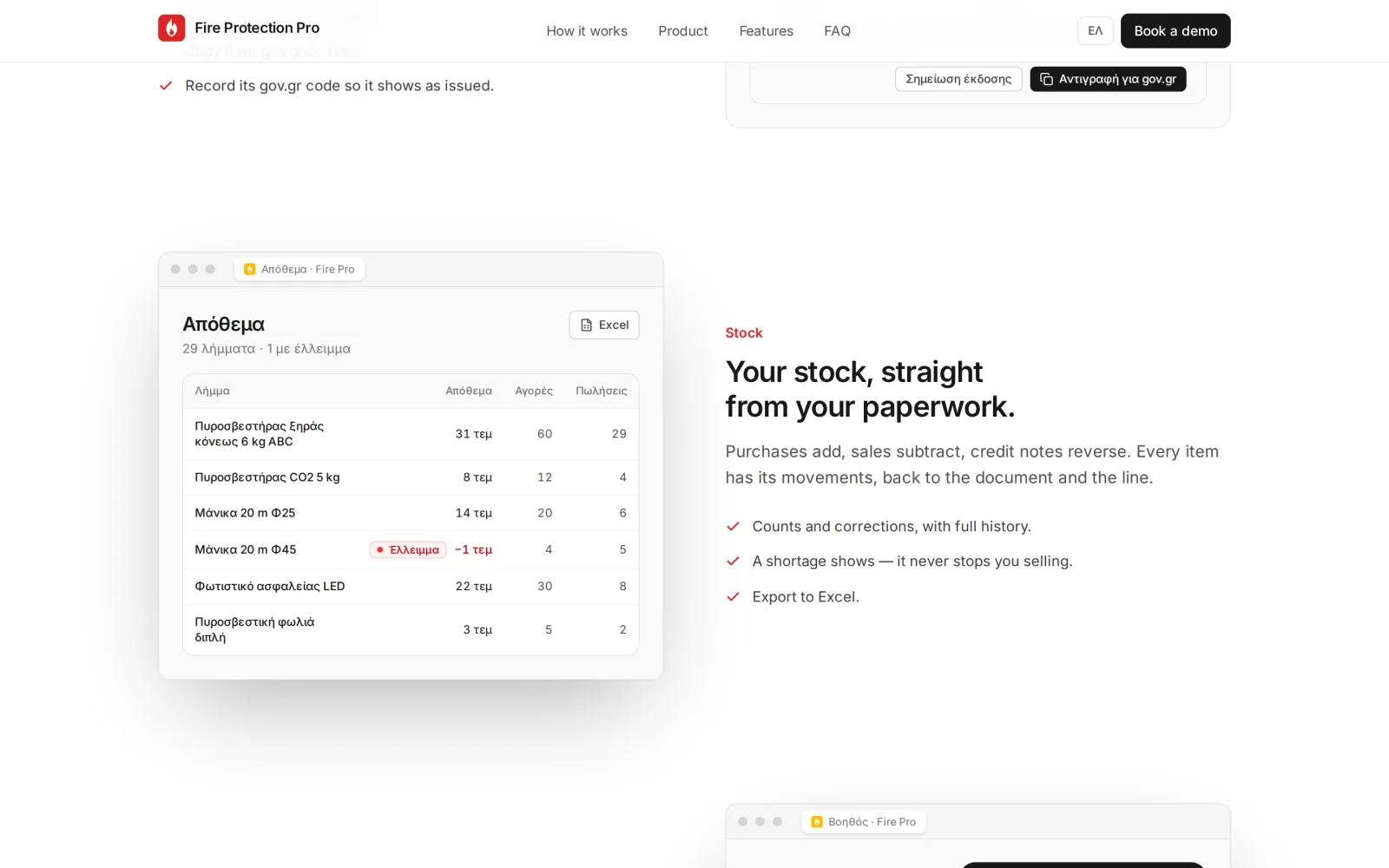
- Stock comes from the same documents: purchases add, sales subtract, credit notes reverse. Counts and corrections are only ever added, and a shortage shows without blocking a sale.
- Each installation's account: what was invoiced, line by line and by trade, in materials, services and technicians, with net, VAT and total, and an Excel export.
- Clients with their invoices, paid and outstanding, and their installations.
Assistant, roles and history
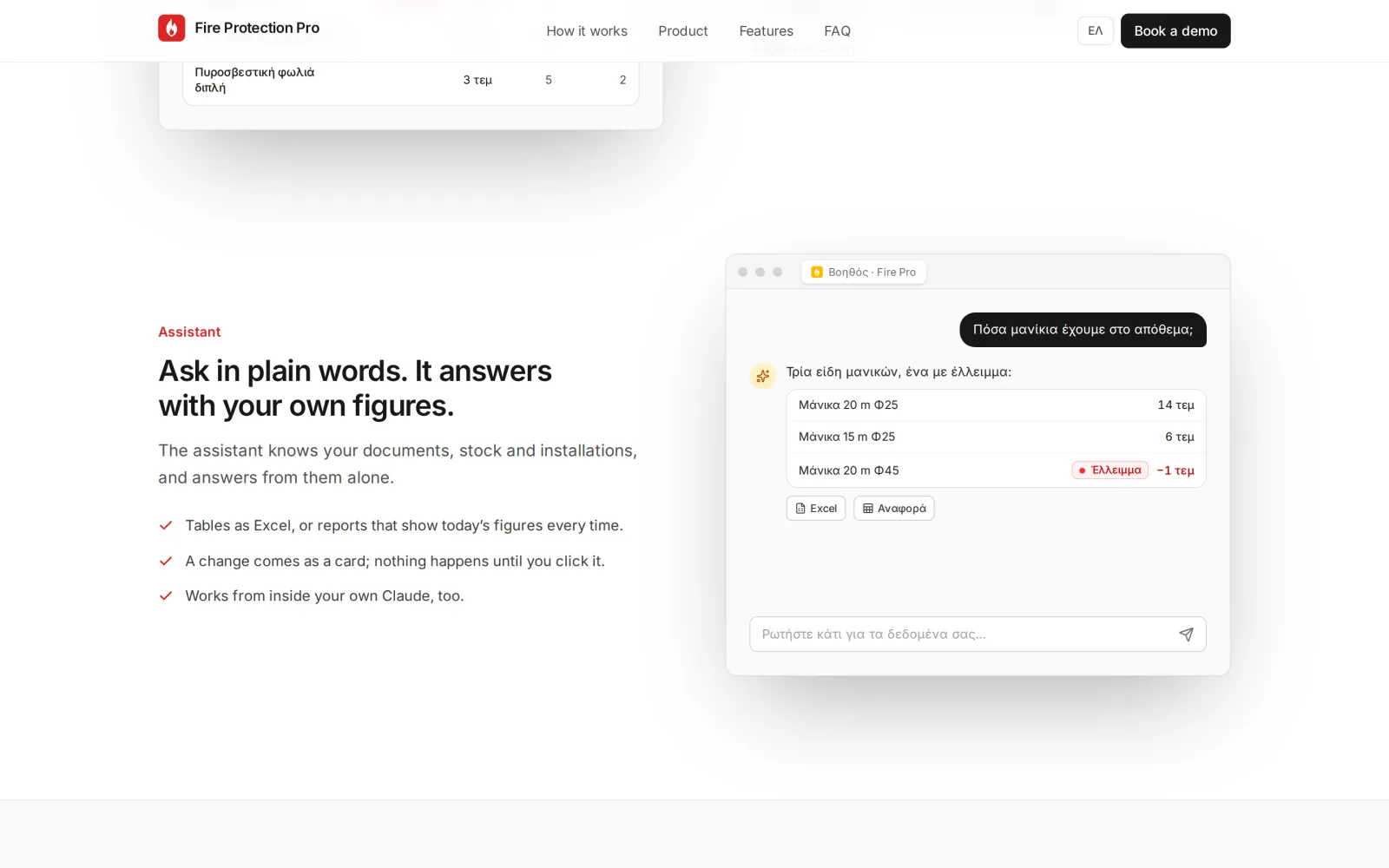
Claude · MCP- An assistant answers in Greek from the company's documents, stock and installations. It builds tables for Excel and saves reports that rerun on today's figures.
- It proposes a change only as a card; nothing changes until a person clicks it.
- The same assistant works inside a user's own Claude, through an MCP server, with the same permissions as on screen.
- Three roles, admin, accountant and manager, enforced by the database, not just by the screens.
- No sign-up: an admin creates every account, and an account is disabled, never deleted.
- Original files and every reading are kept; visits, declarations and stock counts are only ever added.
- It reads the documents a company already issues and receives. It doesn't issue invoices or replace the accounting software or myDATA.
- The landing page, pirosvesi.gr: a static Next.js site on Vercel, Greek at the root and English at
/en. Demo requests come by email.
From the invoice to the next visit
Office or site
Upload
A supplier's invoice, a delivery note, a technician's Excel or the company's own invoice to a client: PDF, scan, photo or XML.
Claude
Read
Claude reads it into a proposal; an e-invoice's XML is read by code. Nothing counts yet.
Accountant or admin
Confirm
A person checks the proposal beside the original, with duplicates and mismatched totals flagged, and confirms.
Postgres
Count
SQL updates the stock and the installation's account. The browser never sums.
Each installation
Schedule
An extinguisher invoice books the next service and hydraulic test, and each task turns due 30 days ahead.
Each confirmation teaches the vocabulary a supplier's wording, so the next invoice needs fewer fixes.
Screens
Built with
- Next.js
- React
- TypeScript
- Tailwind CSS
- Supabase (PostgreSQL)
- Claude
- MCP
- ExcelJS
- Vercel
Ready to get started?
Tell us about your goals — we'll propose milestones within 48 hours.