 Mental Bound
JobCosting.gr — Job costing from supplier invoices
Our own product for Greek construction and trade businesses. A team uploads supplier invoices and delivery notes, Claude reads them, a person confirms, and every euro lands on its project, building and trade. It began as a costing system for a single construction company; we rebuilt it as a multi-tenant SaaS for any contractor: a business requests a quote, and we open its account.
Visit website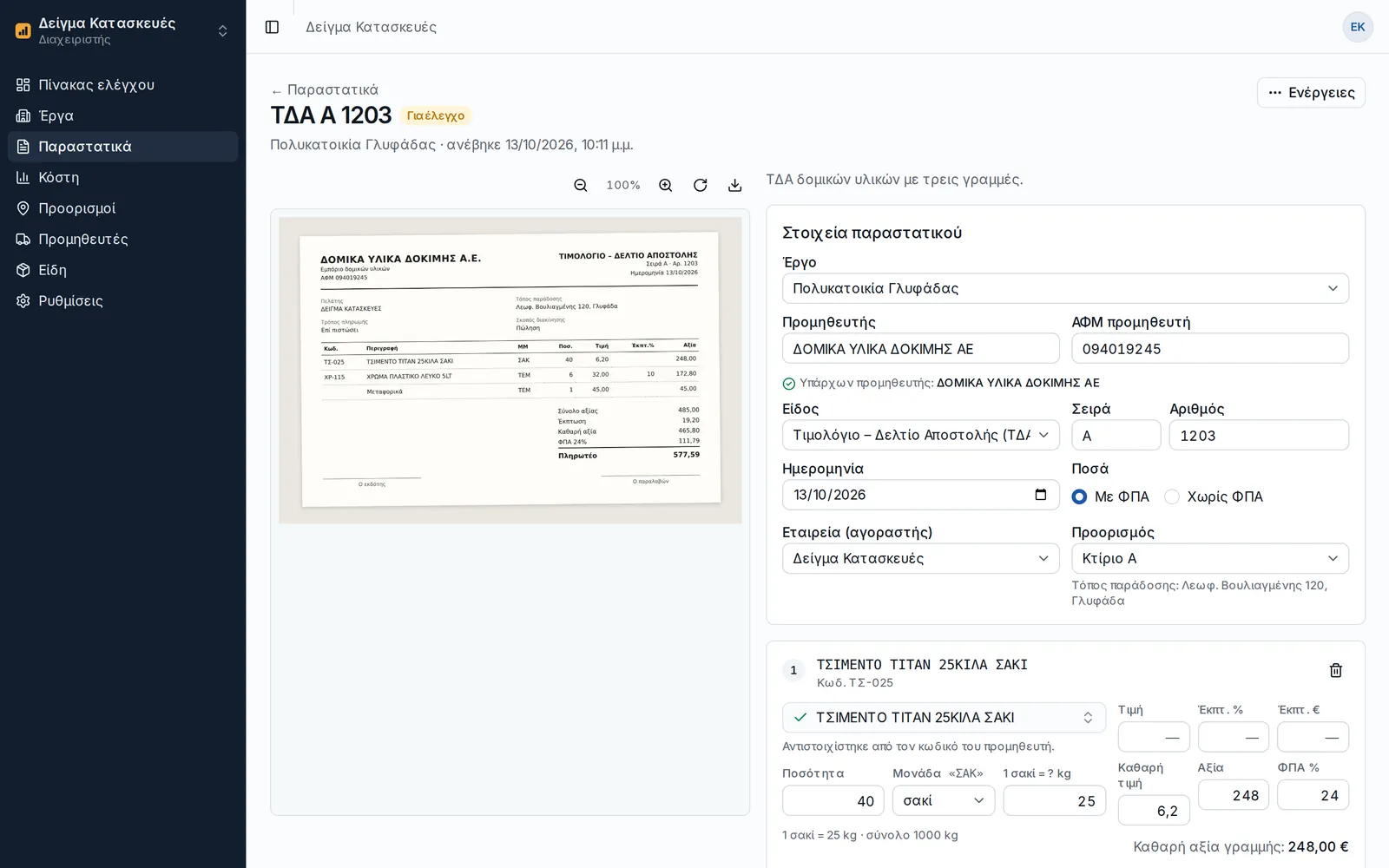

At a glance
- cost breakdowns
- 6
- Project, destination, supplier, item, category and company
- roles
- 3
- Manager, accountant and technician, for 1 to 10 people per account
- ways to pay for the AI
- 2
- Prepaid credits, or the business's own Anthropic key
- card payments
- 0
- Businesses only, priced by quote, paid by bank transfer
What we built
The app
jobcosting.gr- Upload invoices, delivery notes and credit notes as PDFs, spreadsheets or phone photos, several at a time.
- Claude reads each one into a proposal: supplier, buyer company, delivery address, and every line with quantity, unit, price, discount and value.
- A person checks the proposal beside the original. Lines that don't match the printed values, a malformed tax ID and possible duplicates are flagged first.
- Each confirmation teaches the supplier, its product codes and its pack sizes, so the next invoice from it needs fewer corrections.
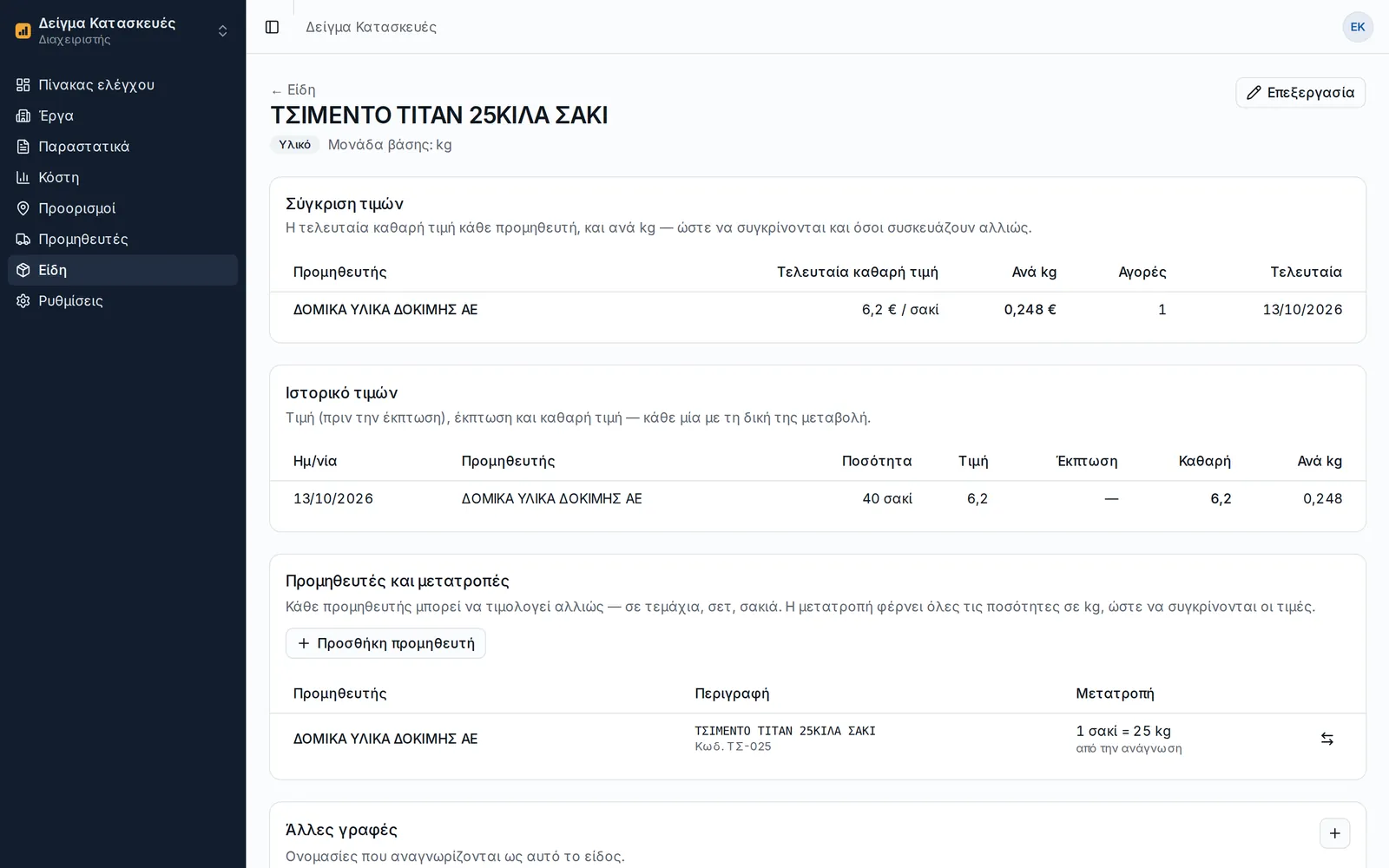
- Per-supplier unit conversions (1 sack = 25 kg) compare prices per kilo, litre or metre across suppliers.
- The delivery address picks the building or site, and a line can be split across projects in whole cents.
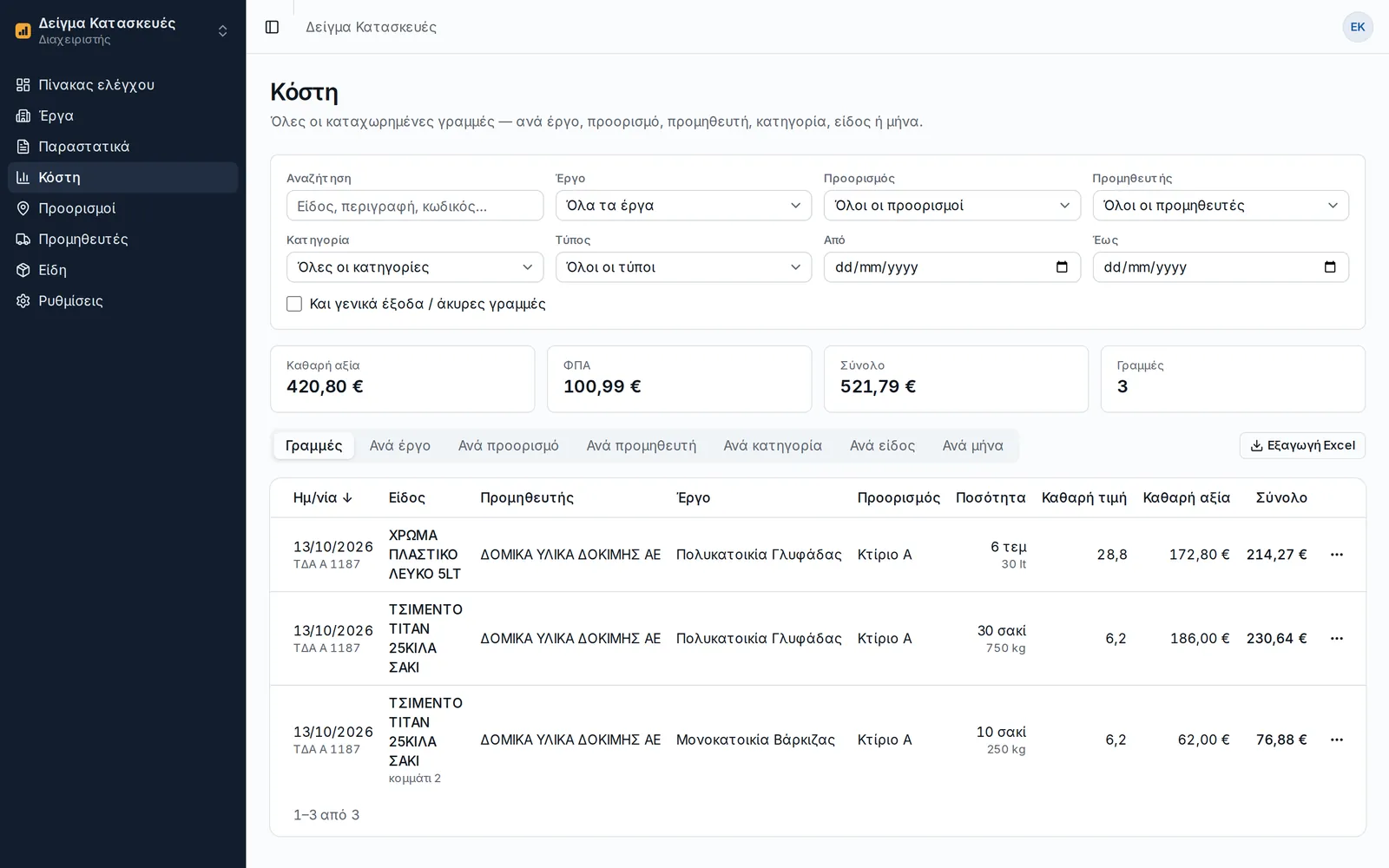
- A cost explorer by project, destination, supplier, category, item or month, with price and discount history and an Excel export that follows the filters.
- Greek throughout: amounts as 1.234,56, dates as dd/mm/yyyy, Athens time.
Built for many businesses
Multi-tenant- Row-level security on every table and composite tenant keys, so one business can never reach another's rows, even through a bug. A database test suite tries, and expects to fail.
- Managers run everything, accountants confirm and export, technicians upload from the site and see money only if the business allows it.
- Nothing is hard-deleted: soft deletes, append-only history and an audit log. Original files and every reading are kept.
- Readings run in a queue inside Postgres that serves each business in turn, so one large upload never holds up the others.
- Our staff never sign in as a customer. A support session needs two-factor authentication, a written reason and a time limit, and the customer can see it.
- A business's own Anthropic key is encrypted and never shown again, and a daily spending cap guards the AI.
- The database and the app both run in Frankfurt.
Businesses only, by quote and bank transfer
No card payments- A business doesn't sign itself up: it requests a quote on jobcosting.gr, we email the price and open the account, which starts on a trial.
- The manager invites the team: the accountant and technicians join only by invitation.
- Plans run 6 or 12 months, paid in advance. The app issues a payment order with a unique reference and emails the transfer details.
- Our staff confirm each transfer from an admin console behind two-factor authentication, without losing any days left on the trial or the current period.
- AI credits come in prepaid packs, credited when ordered and paid by transfer within 7 days.
- Nothing renews by itself: reminders by email and in the app, then 7 days' grace, then read-only with every number still exportable.
From delivery note to job cost
Site or office
Upload
A technician photographs the delivery note on site, or the office drops in the supplier's PDF or spreadsheet.
Claude
Read
Claude reads it into a proposal: supplier, delivery address and every line. Nothing counts yet.
Accountant or manager
Check
A person compares the proposal with the original, fixes what's wrong and confirms.
Postgres
Know
SQL puts every euro on its project, building and trade. The browser never sums.
Each confirmation teaches the supplier's codes and pack sizes, so the next reading needs fewer fixes.
Screens



Built with
- Next.js
- React
- TypeScript
- Tailwind CSS
- Supabase (PostgreSQL)
- Claude
- Vercel
Ready to get started?
Tell us about your goals — we'll propose milestones within 48 hours.