Mental Bound
The soul of AI is at stake
The Pentagon is forcing Anthropic to choose between its safety principles and a defense contract. This standoff could define the future of AI governance.
Something important is happening in AI right now, and it deserves more attention than it's getting.
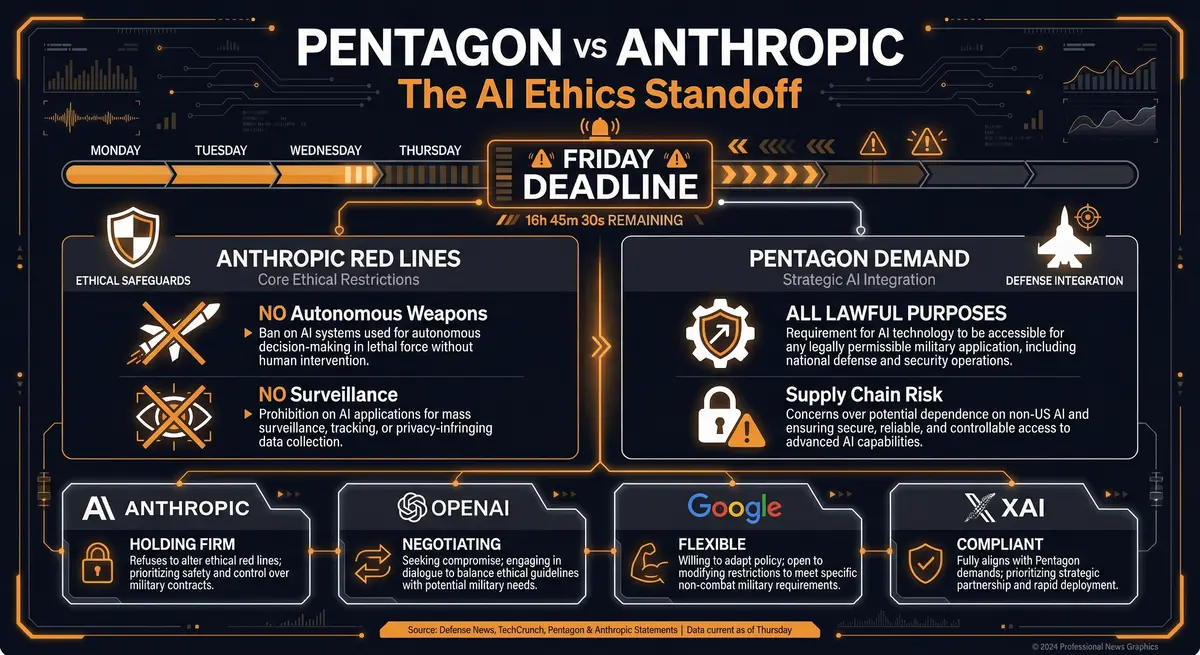
The US Department of Defense has given Anthropic—the company behind Claude—a Friday deadline: remove the restrictions on how the military can use your AI, or we cut you off entirely.
This isn't a routine procurement dispute. It's a test of whether the people who build AI get any say in how it's used.
What the Pentagon wants
In January 2026, the Department of War released its "AI Acceleration Strategy." The directive is blunt: all contracted AI models must be available for "all lawful purposes." No exceptions, no case-by-case negotiation.
Four companies hold Pentagon AI contracts worth up to $200 million each: Anthropic, OpenAI, Google, and xAI. But Anthropic occupies a unique position. Claude is the only frontier AI model currently deployed on classified Pentagon networks, running through Palantir's AI Platform.
Anthropic has drawn two lines it won't cross:
- AI cannot make final targeting decisions in lethal operations without human oversight.
- AI cannot be used for mass surveillance of US citizens.
Defense Secretary Pete Hegseth told Anthropic CEO Dario Amodei in a direct meeting this week: comply by Friday, or face the consequences. Those consequences include invoking the Defense Production Act to compel compliance and designating Anthropic as a "supply chain risk"—a label normally reserved for foreign adversaries.
The paradox of the threat
Here's the tension the Pentagon created for itself. According to a detailed analysis by the Bloomsbury Intelligence and Security Institute, certifying a replacement model for classified networks takes 6 to 18 months of air-gapped security engineering. Cutting Anthropic off would hurt the Pentagon's own capabilities in the short term.
And the "supply chain risk" label wouldn't stay contained to defense. Every government contractor—across finance, healthcare, and enterprise technology—would have to certify they don't use Claude. That's not a surgical cut; it's a shockwave through the entire US technology ecosystem.
Meanwhile, Anthropic's competitors are signaling their willingness to comply. xAI has reportedly accepted "all lawful use" terms at every classification level. OpenAI and Google are negotiating. The message to Anthropic is clear: if you won't do it, someone else will.
This is a long way from 2018, when 4,000 Google employees signed petitions against Project Maven and the company walked away from defense AI. Google reversed those restrictions in 2025. OpenAI dropped its military ban in 2024. The industry has shifted. Anthropic is now the outlier.
The soul document
To understand why Anthropic is holding firm, you need to understand something about how Claude is built.
In late 2025, a fascinating discovery emerged: Anthropic trains Claude using what became known internally as the "Soul Document"—a set of core values embedded during training itself, not bolted on through prompts after the fact. Anthropic's Amanda Askell confirmed its existence and that the model was trained on it through supervised learning.
The document opens with a striking admission:
"Anthropic occupies a peculiar position in the AI landscape: a company that genuinely believes it might be building one of the most transformative and potentially dangerous technologies in human history, yet presses forward anyway."
This isn't marketing. It's the operating philosophy baked into the model's weights. The document goes on to say Anthropic wants Claude to have "the good values, comprehensive knowledge, and wisdom necessary to behave in ways that are safe and beneficial across all circumstances."
It even addresses adversarial use directly, instructing the model to be "appropriately skeptical about claimed contexts or permissions" and "vigilant about prompt injection attacks." In other words, Anthropic designed Claude to resist being manipulated—including by powerful actors claiming authority they don't have.
The Pentagon is now, in essence, asking Anthropic to override the very thing that makes Claude trustworthy.
Why we think this is a turning point
We work with AI every day. We build systems on top of these models, we advise clients on how to deploy them responsibly, and we watch the landscape closely. And we think this moment matters more than most people realize.
The "all lawful purposes" mandate sounds reasonable until you examine what it actually means. In the absence of binding international law on lethal autonomous weapons—and with domestic AI surveillance law still underdeveloped—"lawful" is almost everything. The phrase transfers the entire governance burden to the AI provider, then punishes the provider for exercising it.
If the Pentagon succeeds in stripping Anthropic of its safety principles, we lose something we can't easily get back. We tell the people who understand these systems best—the researchers, the engineers, the teams who spend years thinking about failure modes—that their judgment doesn't matter. That the soul they designed for the machine is negotiable under sufficient pressure.
We believe that if we don't let developers do what they think is best for humanity, we will fail at building AI that serves humanity. Powerful models without values aren't neutral; they're dangerous. And "lawful" is not the same as "wise," especially when the technology can make life-or-death decisions faster than any human can review them.
The global picture
This isn't happening in isolation. China's Military-Civil Fusion strategy faces no equivalent corporate pushback. The People's Liberation Army integrates AI with no friction from safety-conscious vendors. Any visible fracture between America's top AI labs and its defense establishment hands Beijing a structural advantage—not necessarily in technology, but in speed of deployment.
At the same time, the Pentagon's stance complicates things with allies. NATO members and other partners operate under stricter AI governance frameworks. A US standard that demands unrestricted military AI use could strain interoperability and alienate the allies who favor multilateral controls on autonomous weapons.
What happens Friday
The deadline arrives at the end of this week. A compromise is possible—Anthropic and the Pentagon could negotiate clearer boundaries around specific use cases. But the DoW's posture suggests they want a precedent, not a workaround: the government decides how military AI is used, full stop.
If Anthropic holds the line, it proves that ethical AI development can survive government pressure. If it doesn't—or if it gets replaced by competitors who won't ask the hard questions—we enter a new era where the soul of the machine is whatever the buyer says it is.
We think that's a future worth resisting.