Mental Bound
The Inevitable Integration: Why Every Business Will Run on AI
AI integration is moving from competitive advantage to business necessity. Here's how intelligent systems are becoming infrastructure — and why the cost of waiting is compounding.
The question is no longer if businesses will integrate AI — it's when and how deeply.
We're past the experimental phase. AI has moved from boardroom buzzword to operational reality. Companies that treated machine learning as a side project are now rebuilding core processes around intelligent systems. The shift is structural, not cosmetic.
From Tool to Infrastructure
Early AI adoption followed a predictable pattern: pilot projects, isolated use cases, discrete applications. A chatbot here, a recommendation engine there. Useful, but contained.
That's changing. Modern AI integration looks less like adding features and more like rewiring infrastructure. Instead of "AI-powered" products, we're seeing products that couldn't exist without AI.
What Changed
Three factors accelerated this transition:
1. Foundation models became commoditized
GPT-4, Claude, Gemini — world-class language understanding is now an API call away. The barrier to entry dropped from "assemble a team of ML PhDs" to "write a function."
2. Operational AI got practical
Tools matured beyond demos. Retrieval-augmented generation (RAG), vector databases, agent frameworks — these aren't research projects anymore. They're production patterns with known failure modes and mitigation strategies.
3. Cost economics flipped
AI went from "expensive to run" to "expensive not to run." When a language model can process support tickets at $0.002 per interaction versus $8 for human handling, the math becomes unavoidable.
Where AI Integration Happens First
Not every business process benefits equally from intelligence. Some transformations are already standard:
Customer-Facing Operations
- Support & service: Intelligent triage, automated resolution, escalation only when context demands it
- Sales qualification: Lead scoring, personalized outreach, meeting prep automation
- Product recommendations: Real-time personalization based on behavior, not just demographics
Internal Operations
- Document processing: Contract analysis, invoice extraction, compliance checking
- Knowledge management: Semantic search across company data, auto-generated summaries
- Workflow orchestration: AI agents that route tasks, trigger actions, handle exceptions
Strategic Functions
- Market intelligence: Automated competitive analysis, trend detection, signal aggregation
- Financial planning: Scenario modeling, anomaly detection, forecast adjustments
- Talent operations: Resume screening, interview scheduling, skill gap analysis
The Integration Playbook
Successful AI integration doesn't start with technology — it starts with process clarity.
1. Map Repetitive Decisions
Look for tasks where humans apply consistent logic to varying inputs. These are prime candidates:
- "If X, then Y" workflows
- Classification and categorization
- Data extraction and validation
- Pattern recognition at scale
2. Start Where Data Exists
AI needs input. The best early wins come from processes that already generate structured records:
- CRM interactions
- Support ticket history
- Transaction logs
- Email trails
3. Build Feedback Loops
Intelligence improves with correction. Design systems that capture:
- When AI gets it right (reinforce)
- When AI gets it wrong (correct)
- When humans override (learn)
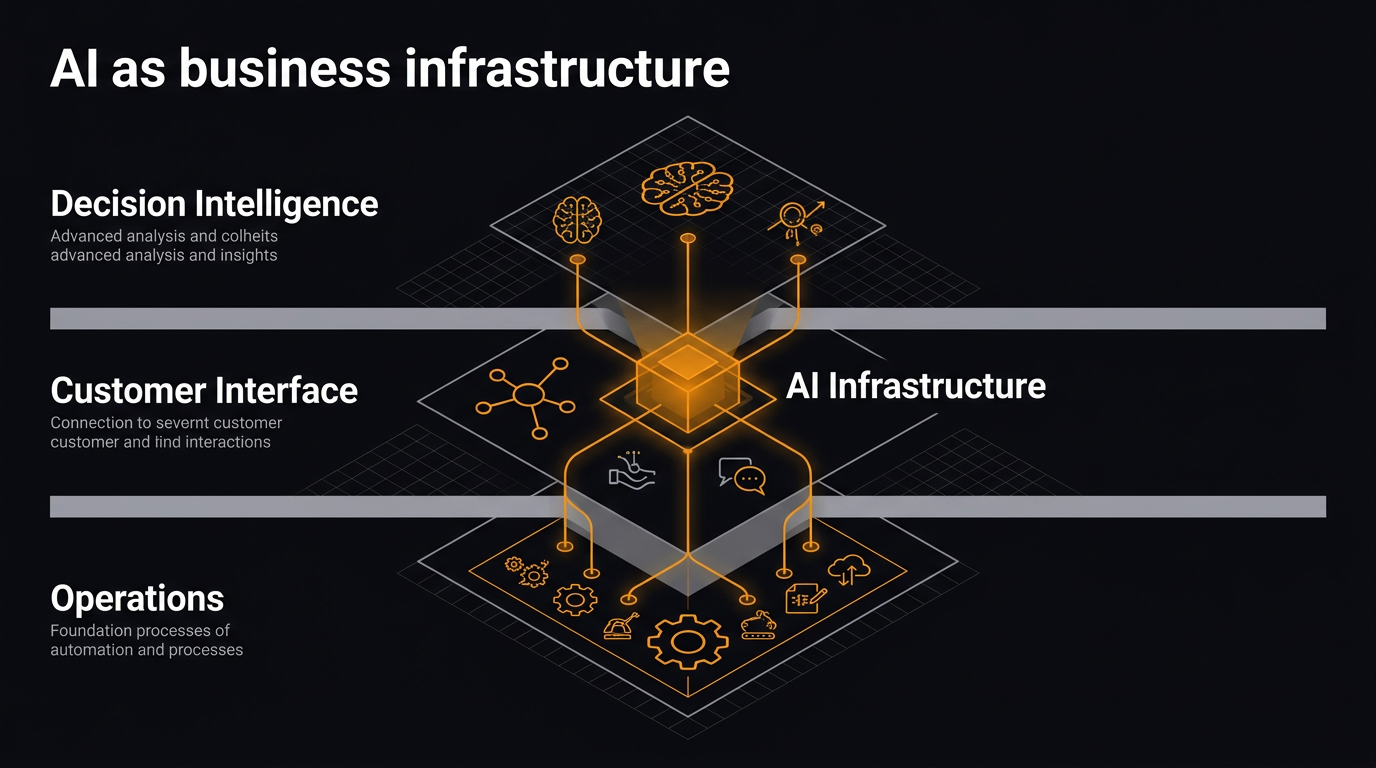
4. Treat AI as Infrastructure
Don't build point solutions. Build platforms:
- Shared embedding models for semantic understanding
- Centralized vector stores for knowledge retrieval
- Agent frameworks for orchestration
- Monitoring and observability from day one
What This Means for Business Strategy
AI integration changes competitive dynamics in subtle ways:
Speed becomes the differentiator
When everyone has access to similar models, advantage comes from how quickly you can deploy them. Execution speed beats model selection.
Data moats strengthen
The value of proprietary data compounds. Your customer interactions, domain knowledge, and operational history become training signal competitors can't replicate.
Technical debt accelerates
Legacy systems that were "good enough" become bottlenecks. You can't integrate AI with mainframes running COBOL or databases with no API layer.
Talent requirements shift
You need fewer ML specialists and more "AI-native" builders — engineers who know when to use a language model, how to prompt effectively, and how to chain systems together.
The Risk of Waiting
"We'll integrate AI when it's more mature" sounds prudent. It's not.
Every quarter you delay:
- Competitors accumulate more training data from live deployments
- Your team falls further behind on implementation knowledge
- Customer expectations rise based on what others deliver
- The gap between your operations and best-practice widens
AI integration has a learning curve. The companies that started two years ago are now on their third iteration. They've hit the failure modes, built the guardrails, trained the teams. Catching up takes time you may not have.
Getting Started
If your business hasn't begun serious AI integration:
This month:
Audit one high-volume, low-stakes process. Support ticket categorization, meeting note summarization, email draft generation — something with clear inputs, defined outputs, and low consequence if wrong.
This quarter:
Deploy an internal AI tool. Not customer-facing, not mission-critical. Build institutional muscle for prompt engineering, output validation, and feedback collection.
This year:
Integrate AI into one revenue-generating or cost-saving process. Measure impact. Iterate. Scale what works.
Key Takeaways
- AI integration is transitioning from competitive advantage to baseline expectation
- Foundation models commoditized intelligence; execution speed is the new moat
- Start with repetitive decisions in data-rich processes
- Build platforms, not point solutions
- Delay has compounding cost — the learning curve is real
The future of business isn't "AI-powered." It's just business — and intelligence is assumed.
Building AI-native systems? We specialize in practical integration — RAG pipelines, agent orchestration, and production-grade deployments. Let's talk.