Mental Bound
Solarpunk and the AI Era: Building the Future We Should Hope For
Why solarpunk's optimistic vision of technology in harmony with nature is exactly what we need as AI transforms everything we build.
We're living through a transformation that happens once in generations. AI systems are rewriting what's possible in software, reshaping how we work, and forcing us to reimagine what technology means for society. But as we build faster, smarter, and more autonomous systems, there's a question we don't ask enough: what kind of future are we building toward?
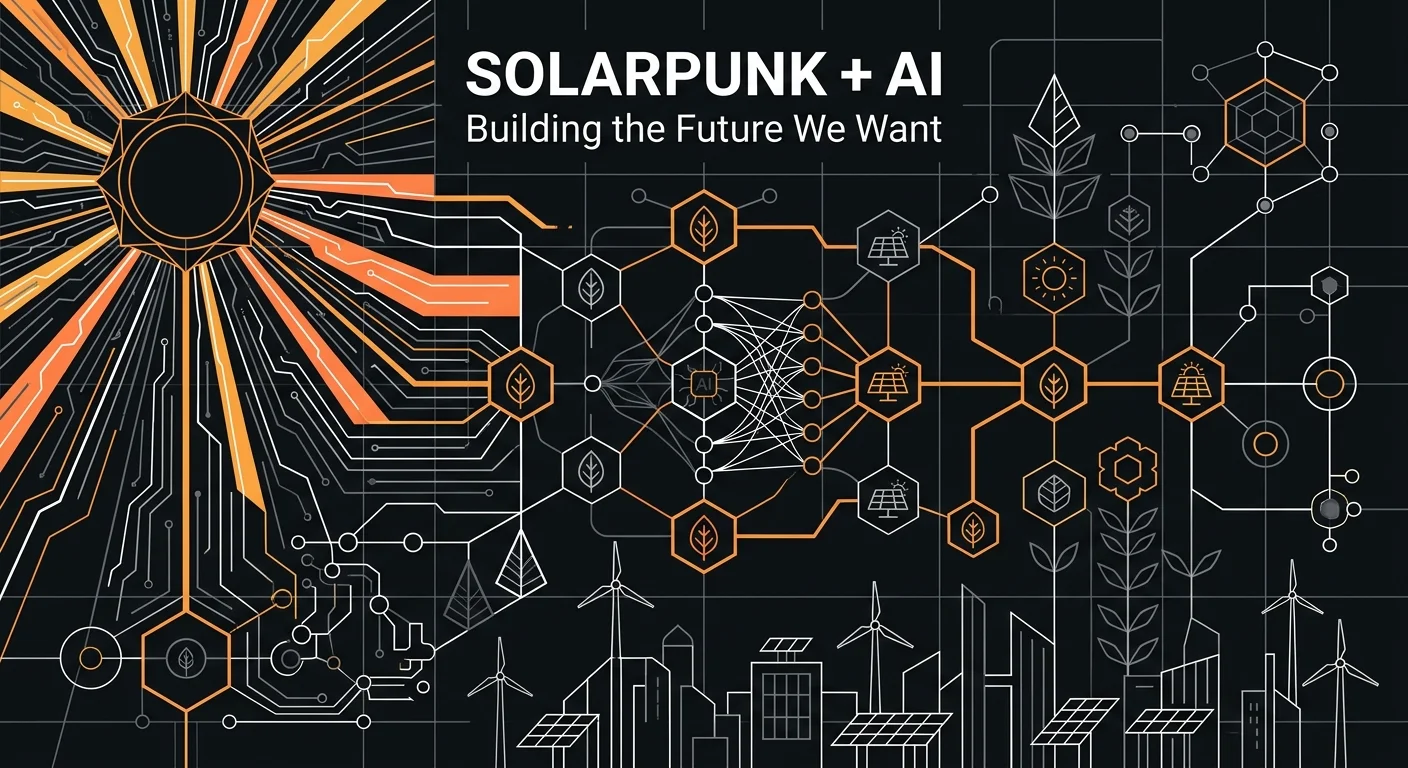
Most visions of an AI-powered future collapse into two camps: techno-utopian fantasies where AI solves everything with zero friction, or dystopian nightmares of surveillance, corporate control, and ecological collapse. Both miss something critical. We need a third vision — one that's optimistic but grounded, technologically sophisticated but ecologically conscious, human-centered but not nature-dominating.
We need solarpunk.
What Is Solarpunk?
Solarpunk is a literary, artistic, and social movement that envisions a sustainable future deeply interconnected with nature and community. The "solar" represents renewable energy and an optimistic rejection of climate doomerism. The "punk" represents the countercultural, do-it-yourself, post-capitalist ethos of actually building that future rather than waiting for permission.
Born in 2008 as a response to the relentless stream of dystopian futures dominating science fiction, solarpunk asks a deceptively simple question: what does a sustainable civilization look like, and how can we get there?
It's driven by a need for people to imagine a better future from where we actually are — not a fantasy world set in an unfamiliar, unlikely timeline. A shining vision grounded in our existing world, one that emphasizes environmental sustainability, self-governance, and social justice.
Picture cities where vertical forests climb skyscrapers covered in solar panels. Community gardens woven between apartment blocks. Public transit powered entirely by renewable energy. Technology that repairs itself, that's built to last, that's designed from the ground up to work with natural systems rather than against them.
This isn't naïve optimism. Solarpunk is an eco-futurist movement that tries to think our way out of catastrophe by imagining a future most people would actually want to live in — not one we should be trying to avoid. It's a rebellion against the structural pessimism baked into most visions of the future, replacing despair with cautious, actionable hopefulness.
Why It Matters Now More Than Ever
As an art movement, solarpunk emerged in the 2010s as a reaction to bleak post-apocalyptic media, growing awareness of social injustices, accelerating climate change, and seemingly inextricable economic inequality. But its relevance has only deepened since.
In 2026, we're not just watching climate change unfold — we're living it. Extreme weather events are no longer outliers. Young people carry crushing eco-anxiety. And at the same time, we're developing AI systems that will fundamentally reshape society within our lifetimes.
This convergence matters. AI is the most powerful tool we've ever built for solving complex problems. But tools reflect the values of their creators and the systems they operate within. What necessarily precedes a shift in the outcomes of our technology is a shift in the beliefs that guide their creation. Technology serves as a means to an end, not an end in itself — a tool through which we pursue a new compass heading: the sustenance and well-being of our ecosystems.
If we build AI systems within the same extractive, growth-at-all-costs paradigm that created the climate crisis, we'll simply accelerate toward the same cliff. But if we build them with solarpunk principles — technology that enables rather than controls, that distributes rather than concentrates, that repairs rather than replaces — we might actually create something worth inheriting.
The "Punk" in Solarpunk
The aesthetic gets the attention: lush greenery, art nouveau curves, warm sunlight streaming through transparent solar panels. But the philosophy is what gives solarpunk its teeth.
"The 'punk' element in solarpunk refers to the movement's unapologetically optimistic take on the future despite our growing pessimism and even apathy, and passionately calls for radical societal change. Solarpunks are 'against a shitty future.'"
This isn't about slapping plants on buildings and calling it progress. Solarpunk explicitly warns against greenwashing — aesthetics that give the appearance of sustainability without addressing root causes. Luxury condominiums with green roofs that price out existing communities are textbook examples of "fake solarpunk urbanism."
Real solarpunk demands something deeper:
- Decentralization over corporate control. A society where people and the planet are prioritized over profit, built on decentralized, open-source technologies, shared knowledge, and community ownership.
- Repair over replacement. Building things that last, that can be fixed, that don't lock you into proprietary ecosystems designed for planned obsolescence.
- Community over individualism. Shared infrastructure, collective ownership, mutual aid networks — the architecture of mutual care.
- Appropriate technology. Innovation driven by genuine commitment to preserving both human and ecological well-being, redefining progress from maximizing profit to optimizing the intertwined health of humanity and the environment.
Look at that list and tell me it doesn't sound like the antidote to every problem plaguing modern tech.
Technology as Scaffolding, Not Control
Technology should be at the service of the living, acting as a support rather than a controlling force — a scaffold, an ephemeral base that allows living systems to develop and flourish.
AI agents should enable human agency, not replace it. Systems should be transparent, not black boxes. Infrastructure should empower communities to solve local problems, not centralize control in distant data centers.
Built to Last, Built to Repair
Solarpunk embraces low-tech sustainability alongside high-tech innovation: permaculture, regenerative design, tool libraries, maker spaces, open-source everything, and do-it-yourself ethics.
What if we designed AI systems with the same care we'd give to tools meant to last generations? Open weights, documented architectures, modular components you can swap out and fix. Not optimized for quarterly growth, but for genuine utility over decades.
Distributed Intelligence
The integration of technology into society in a manner that improves social, economic, and environmental sustainability is central to the solarpunk vision. Whereas cyberpunk envisions humanity becoming alienated from nature and subsumed by technology, solarpunk envisions a world where technology enables humanity to better co-exist with itself and its environment.
AI doesn't have to mean massive data centers consuming city-sized energy budgets. Edge computing, federated learning, models that run locally on modest hardware — these aren't just technical choices, they're political ones. They determine who controls the infrastructure and who benefits from it.
Measuring What Matters
Doughnut economics measures the success of an economy not by GDP, but by its ability to secure well-being for its people within the ecological limits of the planet — ensuring a just, equitable, and prosperous society that doesn't rely on rampant extraction.
We optimize what we measure. If we measure only inference speed and model accuracy, we'll build systems that are fast and precise but potentially extractive and harmful. What if we also measured energy efficiency, accessibility, repairability, and genuine human benefit?
The AI Revolution Needs a Counter-Narrative
The dominant narratives around AI are exhausting. Either it's the singularity and we're all obsolete, or it's AGI and we're all saved, or it's corporate surveillance capitalism on steroids and we're all screwed. None of these help us build better systems.
Solarpunk offers something radically different: a vision where AI enhances human capability without replacing human agency. Where automation frees us from drudgery to do more meaningful work — in community gardens, in local workshops, in caring for each other and the planet. Where intelligent systems help us optimize for sustainability rather than extraction.
This isn't fantasy. Researchers are already studying vermicompost energy production. Open-source networks are making software free to access and establishing communal ownership of technology. Solarpunk's influence on the present is tangible and growing.
Solarpunk's unwavering optimism can help fuel concrete, practical steps toward a future people actually want. That's what separates it from idle daydreaming — it's a movement with both a vision and a blueprint.
Building It in Practice
At Mental Bound, we work at the intersection where traditional engineering rigor meets cutting-edge AI systems. We build production software that actually solves problems, not demos that look impressive in pitch decks.
Applying solarpunk principles means:
- Choosing open source where we can, contributing back what we build
- Optimizing for real efficiency — not just nominal performance, but the full lifecycle cost of what we ship
- Building for maintainability and longevity, not just fast iteration cycles
- Designing for accessibility and inclusion from the ground up, not as an afterthought
- Being transparent about capabilities, limitations, and trade-offs
- Measuring impact holistically — energy use, accessibility, who benefits, who might be harmed
It means asking "should we build this?" alongside "can we build this?"
It means recognizing that the most sophisticated technology isn't the one with the most parameters or the fastest inference time — it's the one that genuinely improves lives while respecting planetary boundaries.
The Future We Build Together
"As our world roils with calamity, we need solutions, not only warnings — solutions to thrive without fossil fuels, to equitably manage scarcity and share in abundance, to be kinder to each other and the planet we share. Solarpunk is at once a vision of the future, a thoughtful provocation, a way of living and a set of achievable proposals to get there."
The AI revolution is happening whether we like it or not. Models will get more capable, systems will get more autonomous, and the technology will reshape work, creativity, and society in ways we're only beginning to understand.
The question isn't whether we'll have AI-powered futures. The question is what kind.
Solarpunk reminds us that optimism is an act of rebellion. That imagining better futures is the first step to building them. That technology shaped by values of community, sustainability, and genuine human flourishing looks radically different from technology shaped by quarterly earnings and winner-take-all competition.
We're building agentic systems that can reason, plan, and act. That's extraordinary. Now let's build them in service of a world we'd actually want to live in — one where intelligence, both human and artificial, helps us repair rather than extract, distribute rather than concentrate, and thrive within planetary boundaries rather than exceed them.
The point of solarpunk is to start telling a new, creative story — illustrating a world where humans don't live in opposition to nature, where we don't forfeit the advancements of modern life, but instead flourish in harmony with the environment.
That's the future we should hope for. That's the future we can build.
The punk part? Building it anyway, even when the incentives push the other direction. The solar part? Doing it with optimism, beauty, and the belief that technology can genuinely make things better.
Key Takeaways
- Solarpunk is not aesthetic escapism — it's a grounded movement demanding sustainable, community-centered technology that works with nature, not against it.
- AI amplifies whatever values we encode into it. If built within extractive paradigms, AI accelerates ecological harm. If guided by solarpunk principles, it can accelerate repair.
- The "punk" demands action — decentralization, open-source, repair culture, and genuine community ownership over the tools that shape our lives.
- Practical solarpunk in software means measuring energy use, designing for longevity, choosing open architectures, and asking "should we?" before "can we?"
- Optimism is a design choice — and possibly the most radical one we can make in an industry addicted to dystopian narratives.
Interested in building AI systems that serve people and planet? Get in touch.